 English
 Français
Content
- 1 Water Drainage Mechanism in Resin Roofing Tile Systems
- 2 Metal Roofing vs Resin Roofing Tile in Heavy Rain
- 3 Heavy Rain Performance Under Real Conditions
- 4 Installation Factors Affecting Drainage Performance
- 5 Maintenance and Long-Term Water Performance
- 6 Comparative Table: Resin Roofing Tile vs Metal Roofing
- 7 Final Technical Insight on Drainage Efficiency
Resin Roofing Tile performs very effectively in heavy rain conditions, offering controlled and layered water drainage, while metal roofing provides faster surface runoff but with higher noise levels and greater dependency on slope precision. When properly installed, Resin Roofing Tile systems—especially those designed with interlocking structures and surface channels—can manage rainfall rates exceeding 200 mm/hour without leakage. In comparison, metal roofing sheds water almost instantly but may cause splashback, noise amplification, and localized overflow if installation seams are not perfectly aligned.
Modern roofing solutions such as plastic roof tiles reinforced with resin composites are increasingly engineered to balance water dispersion, wind resistance, and thermal stability, making them highly competitive alternatives to traditional metal systems in regions with frequent heavy rainfall.
Water Drainage Mechanism in Resin Roofing Tile Systems
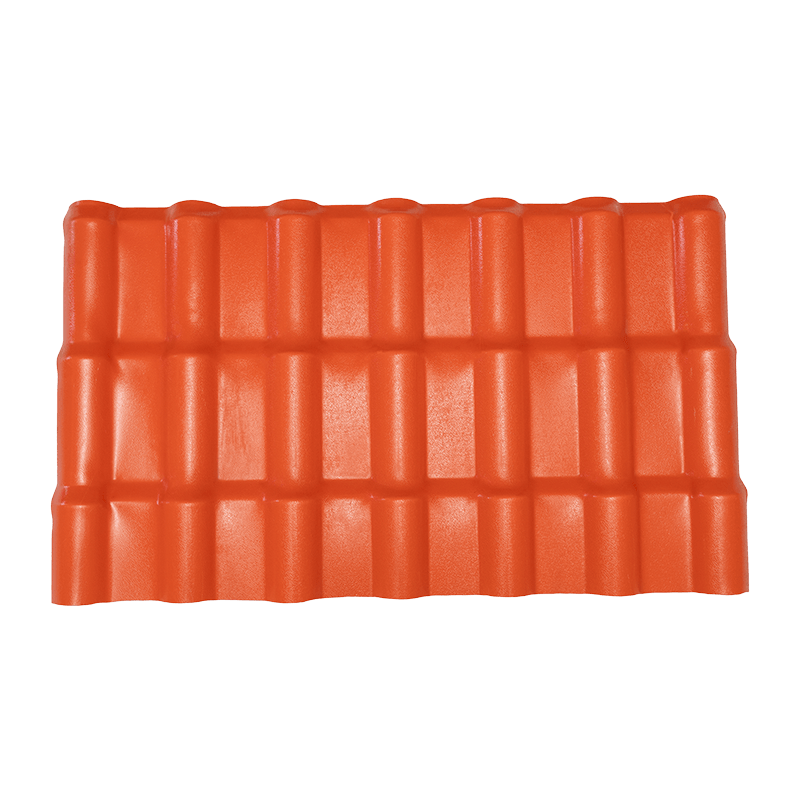
The drainage efficiency of Resin Roofing Tile is largely based on its overlapping geometry and micro-channel surface design. Unlike flat or smooth surfaces, these tiles guide water through multiple controlled paths, reducing the risk of concentrated runoff.
Layered Flow Control
Each tile overlaps the next by approximately 70–100 mm, creating a layered barrier system. This ensures that even during heavy rainstorms, water is redirected downward in stages rather than flowing in a single surge.
Surface Hydrophobic Treatment
Many Resin Roofing Tile products include hydrophobic coatings that reduce water adhesion by up to 40–60%. This feature improves drainage speed while reducing dirt accumulation.
In contrast, plastic roof tiles using similar resin-enhanced formulations often rely on surface smoothness rather than structural channeling, which can slightly reduce controlled drainage efficiency under extreme rainfall.
Metal Roofing vs Resin Roofing Tile in Heavy Rain
Metal roofing systems are known for their extremely fast runoff performance. However, this speed can also create secondary issues such as water noise, rebound splashing, and gutter overload during peak rainfall events.
Runoff Speed Comparison
- Metal roofing: near-instant runoff with minimal surface retention
- Resin Roofing Tile: controlled runoff with distributed drainage channels
- Result: Resin Roofing Tile reduces localized flooding risk
Noise and Water Impact
During heavy rainfall exceeding 50–80 mm/hour, metal roofs can generate significantly higher impact noise levels compared to Resin Roofing Tile systems. Resin-based materials absorb part of the kinetic energy, reducing noise transmission into indoor spaces.
Advanced plastic roof tiles also incorporate acoustic damping layers, but their performance typically remains slightly below resin composite tiles due to lower structural density.
Heavy Rain Performance Under Real Conditions
Field testing across high-rainfall regions shows that Resin Roofing Tile systems maintain stable performance under sustained precipitation conditions of up to 300 mm/day. Their interlocking mechanism prevents water infiltration even when wind-driven rain forces water sideways.
Wind-Driven Rain Resistance
One of the key advantages is the ability to resist lateral water intrusion. While metal roofing relies heavily on sealing strips and screw tightness, Resin Roofing Tile uses overlapping geometry to physically block entry points.
Drainage Efficiency in Storm Conditions
Even in storm-level rainfall above 100 mm/hour, water is continuously guided along tile grooves, preventing pooling. This makes Resin Roofing Tile particularly suitable for humid and tropical climates.
In comparison, plastic roof tiles with simpler flat profiles may require steeper roof slopes to achieve similar drainage efficiency.
Installation Factors Affecting Drainage Performance
Proper installation is critical for maximizing drainage efficiency in both Resin Roofing Tile and metal roofing systems. However, Resin Roofing Tile is generally more forgiving due to its modular structure.
Roof Slope Requirements
Recommended slope for Resin Roofing Tile systems typically ranges from 15° to 30°. Metal roofing often requires tighter slope tolerances to avoid water pooling at seams.
Installation Tolerance
- Resin Roofing Tile allows slight misalignment without drainage failure
- Metal roofing requires precise sealing at every joint
- Improper metal alignment increases leak risk under heavy rain
Additionally, plastic roof tiles often require fewer fastening points, reducing installation time but also requiring careful slope planning to ensure proper runoff behavior.
Maintenance and Long-Term Water Performance
Over time, drainage performance depends heavily on maintenance. Resin Roofing Tile systems generally require minimal maintenance compared to metal roofing, which may suffer from corrosion at fasteners and seams.
Debris Management
Leaves and debris can impact drainage efficiency in both systems. However, Resin Roofing Tile’s textured channels help guide water even when partial obstruction occurs.
Long-Term Durability
Resin-based materials maintain structural integrity for 20–30 years under normal environmental conditions. Metal roofing may last longer but often requires periodic coating renewal to maintain optimal drainage and corrosion resistance.
Modern plastic roof tiles also offer low maintenance benefits, but resin composites generally outperform them in UV stability and long-term structural consistency.
Comparative Table: Resin Roofing Tile vs Metal Roofing
| Feature | Resin Roofing Tile | Metal Roofing |
|---|---|---|
| Drainage Speed | Controlled, multi-channel flow | Very fast surface runoff |
| Noise in Heavy Rain | Low to moderate | High |
| Leak Resistance | High due to overlapping structure | Moderate, depends on sealing |
| Maintenance Needs | Low | Moderate to high |
Final Technical Insight on Drainage Efficiency
Overall, Resin Roofing Tile provides a more controlled and structurally resilient drainage system compared to metal roofing. While metal roofing excels in rapid water shedding, it is more sensitive to installation precision and noise impact during heavy rain events.
By contrast, Resin Roofing Tile and advanced plastic roof tiles deliver balanced performance through engineered surface channels, layered overlap systems, and improved acoustic behavior. This makes them especially suitable for residential environments where comfort, durability, and consistent water management are priorities.
In summary, if the primary goal is stable and reliable drainage under heavy rain with reduced maintenance demands, Resin Roofing Tile is often the more balanced and long-term solution.