 English
 Français
Content
- 1 What UV Resistance Means for Roofing Materials
- 2 UV Resistance of FRP Shading Tiles
- 3 UV Resistance of Traditional Polycarbonate Roofing Panels
- 4 UV Resistance of Metal Roofing Tiles
- 5 Side-by-Side UV Resistance Comparison
- 6 Key Factors That Determine UV Performance in FRP Shading Tiles
- 7 Application Scenarios Where FRP Shading Tiles Have a Clear UV Advantage
When evaluating roofing and shading materials for long-term outdoor use, UV resistance is one of the most critical performance indicators. FRP Shading Tiles consistently outperform standard polycarbonate panels in UV durability and match or exceed many metal roofing options in corrosion-related degradation resistance — particularly in high-humidity or chemically aggressive environments. This article breaks down the UV resistance comparison across all three material types with specific data, real-world implications, and guidance for buyers.
What UV Resistance Means for Roofing Materials
UV radiation — specifically UVA (315–400 nm) and UVB (280–315 nm) — causes photooxidation in most polymeric and composite materials, leading to surface chalking, color fading, brittleness, and reduced structural integrity over time. For roofing tiles used in shading applications, UV degradation directly affects light transmittance, mechanical strength, and service life.
The industry measures UV resistance through standardized tests such as ASTM G154 (UV fluorescent lamp exposure) and ASTM G155 (xenon arc lamp exposure), which simulate years of outdoor weathering in accelerated timeframes. Color retention is quantified using Delta E values — a Delta E below 3 is generally considered acceptable for architectural applications.
UV Resistance of FRP Shading Tiles
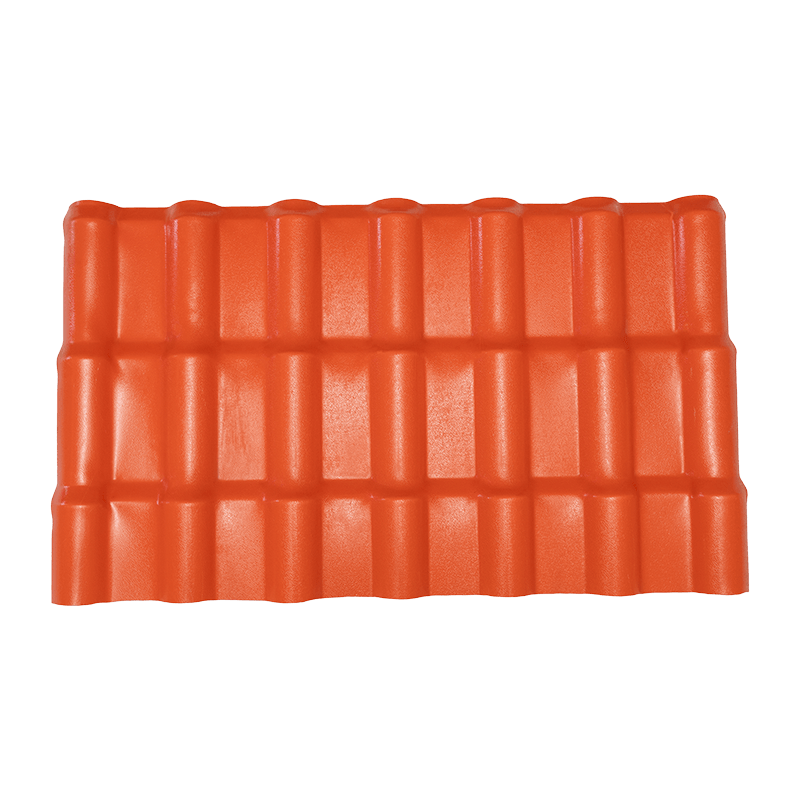
FRP (Fiber Reinforced Polymer) Shading Tiles are manufactured using a glass fiber matrix embedded in a thermosetting resin — typically polyester, vinyl ester, or acrylic-modified variants. The UV performance of FRP Shading Tiles depends heavily on the surface protection system applied during manufacturing.
Gel Coat and UV-Stabilized Surface Layers
High-quality FRP Shading Tiles are produced with a UV-resistant gel coat surface layer containing UV absorbers (UVAs) and hindered amine light stabilizers (HALS). This combination significantly slows photooxidation of the resin matrix. In independent weathering tests, premium FRP Shading Tiles with gel coat protection have demonstrated less than 10% tensile strength loss after 10 years of outdoor exposure in subtropical climates.
Light Transmittance Stability
One of the key advantages of FRP Shading Tiles in shading applications is that their light transmittance — typically ranging from 10% to 40% depending on fiber density and resin pigmentation — remains relatively stable over time when surface protection is applied. Yellowing index increases of less than 15 points over 5,000 hours of UV exposure (per ASTM D1925) have been recorded for surface-coated FRP panels.
Fiber Blooming Risk
A known limitation of FRP Shading Tiles is fiber blooming — the surfacing of glass fibers as the resin erodes under prolonged UV exposure. This typically occurs after 7–15 years in unprotected or economy-grade FRP tiles. However, tiles with protective surface veils (polyester or acrylic films) effectively suppress this phenomenon and extend the service life to 20–25 years.
UV Resistance of Traditional Polycarbonate Roofing Panels
Polycarbonate (PC) is widely used in shading and roofing applications due to its high initial light transmittance (up to 88% for clear sheets) and impact resistance. However, polycarbonate is inherently vulnerable to UV degradation.
Co-Extruded UV Coating Dependency
Virtually all commercial polycarbonate roofing panels rely on a co-extruded UV-protective layer (typically 50–175 microns thick) on the exposed surface. Without this layer, unprotected polycarbonate yellows severely within 12–18 months of outdoor exposure. Even with UV coatings, most polycarbonate panels carry manufacturer warranties of only 10 years for optical clarity, with noticeable yellowing and up to 30% transmittance loss observed by year 12–15 in high-UV regions.
Thermal Cycling and UV Combined Effects
Polycarbonate undergoes significant thermal expansion (coefficient of ~6.5 × 10⁻⁵/°C), and when combined with UV-induced surface embrittlement, micro-cracking at panel edges becomes a common failure mode after 8–12 years. This is a notable structural concern compared to FRP Shading Tiles, which have a lower thermal expansion coefficient and greater dimensional stability under combined thermal and UV loading.
UV Resistance of Metal Roofing Tiles
Metal roofing tiles — including galvanized steel, aluminum, and color-coated steel (PPGI) — respond to UV radiation differently from polymer-based materials. The base metal itself is not degraded by UV, but the organic coating systems applied to metal tiles are subject to photooxidation.
Coating Performance Under UV Exposure
High-quality PVDF (polyvinylidene fluoride) coatings used on premium metal roofing tiles offer outstanding UV resistance, with Delta E color change values below 5 after 20 years of Florida weathering tests — one of the most aggressive real-world UV testing environments. Polyester-coated metal tiles, which are more economical, show significantly faster color fading, with Delta E values exceeding 10 within 7–10 years.
Corrosion as the Primary Failure Mode
Unlike FRP Shading Tiles, which are inherently corrosion-immune, metal roofing tiles face a combined threat: UV degrades the protective coating, which then exposes the base metal to moisture and oxidation. In coastal or industrial environments, this coating breakdown can occur within 5–8 years for standard galvanized steel tiles, necessitating repainting or replacement — a significant lifecycle cost consideration.
Side-by-Side UV Resistance Comparison
| Performance Indicator | FRP Shading Tiles | Polycarbonate Panels | Metal Roofing Tiles |
|---|---|---|---|
| Typical Service Life | 20–25 years | 10–15 years | 15–40 years (coating dependent) |
| UV Protection Method | Gel coat + HALS stabilizers | Co-extruded UV layer | PVDF or polyester coating |
| Color Stability (10 yrs) | Good (Delta E < 5) | Moderate (noticeable yellowing) | Excellent (PVDF) / Poor (polyester) |
| Corrosion Immunity | Full | Full | Coating-dependent |
| Light Transmittance | 10–40% | 25–88% | 0% (opaque) |
| Fiber Blooming Risk | Low (with surface veil) | N/A | N/A |
| UV-Induced Brittleness | Low | Moderate–High | None (base metal unaffected) |
Key Factors That Determine UV Performance in FRP Shading Tiles
Not all FRP Shading Tiles offer the same UV performance. Buyers should evaluate the following factors before procurement:
- Surface veil type: Acrylic or polyester surface veils significantly extend UV protection life compared to bare resin surfaces.
- Resin system: Vinyl ester resins offer superior UV and chemical resistance compared to standard orthophthalic polyester resins.
- Gel coat thickness: A minimum gel coat thickness of 0.4–0.6 mm is recommended for outdoor FRP Shading Tiles in high-UV environments.
- Pigment stability: Inorganic pigments generally offer better UV color fastness than organic pigment systems in FRP composites.
- Third-party UV test data: Request ASTM G154 or G155 test reports from the manufacturer to verify claims independently.
Application Scenarios Where FRP Shading Tiles Have a Clear UV Advantage
FRP Shading Tiles offer a particularly strong UV resistance advantage in the following real-world use cases:
- Greenhouse and agricultural roofing: where light diffusion, UV stability, and chemical resistance to agrochemicals must coexist over 15+ year cycles.
- Carport and parking shade structures: in desert or high-altitude regions where UV index regularly exceeds 10, where polycarbonate panels fail prematurely.
- Industrial walkway canopies: where chemical fume exposure compounds UV-related degradation in both metal coatings and polycarbonate surfaces, but leaves FRP largely unaffected.
- Coastal recreational facilities: where salt spray accelerates metal coating failure, giving FRP Shading Tiles a decisive service life advantage over steel-based alternatives.
The answer depends on what you are comparing. FRP Shading Tiles clearly outperform polycarbonate panels in long-term UV resistance, especially beyond the 10-year mark, where polycarbonate yellowing and embrittlement become practical problems. Against metal roofing tiles, the comparison is more nuanced: PVDF-coated metal tiles offer excellent color stability, but their vulnerability to corrosion once the UV-degraded coating fails gives FRP Shading Tiles a meaningful lifecycle advantage in wet, coastal, or chemically active environments.
For applications that require a balance of partial light transmittance, corrosion immunity, and 20+ year UV durability, FRP Shading Tiles represent the most technically well-rounded solution among the three material categories — provided the tiles are specified with appropriate surface veil and UV-stabilized resin systems.